


We still remember how it all began. The Law "On the Privatization of Property of State-Owned Enterprises," adopted in 1992, aimed to create a multi-structured, socially oriented market economy in Ukraine.
It was planned to build such economic beauty through the divestment of state and communal property in favor of individuals and non-state legal entities. There was plenty of property, and of various kinds: property of state enterprises, unfinished construction projects, and state shares (stakes, stocks) in the authorized capitals of commercial companies (corporate rights).
Every commodity has its buyer. Some needed buildings, others needed unfinished structures. But if you want to acquire a functioning business that cannot be divided into separate property units, then you look toward the privatization of corporate rights. In state-owned enterprises, corporate rights in their direct definition did not exist. For them to appear, it was necessary to transform such state enterprises into entities that possess corporate rights—into commercial companies.
Therefore, in 1993, Presidential Decree No. 210/93 "On the Corporatization of Enterprises" was issued. The Decree set more than enough tasks: to reform the management of the state sector of the economy, to increase the responsibility of state enterprises for the results of their economic activities, and to prepare them for privatization. Since then, corporatization and privatization have gone hand in hand. As it turned out, reforming the management of the state sector of the economy over the decades was unsuccessful.
At least, that was the exact justification announced for the latest reform, which focused its attention on the corporatization of the remaining state enterprises and the introduction of independent supervisory boards. It is worth noting that supervisory boards have always existed in joint-stock companies. To briefly describe their role, they were formed to manage companies between general meetings of shareholders.
The procedure for holding a general meeting of a joint-stock company, when there are at least two shareholders, is quite slow. As a general rule, the notice of convocation is sent to shareholders no later than 30 days before it is held. There is also a 15-day notice period, but that is an exception to the general rule. All of this takes a lot of time. Supervisory boards meet quickly and make managerial decisions on important matters of the joint-stock company between general meetings. Another case is when a joint-stock company has a single shareholder.
This includes a significant portion of companies with a state share. In such cases, general meetings are not called, and the state management body adopts decisions through its own regulatory act. At first glance, it seems that a supervisory board is not needed in this case. But according to the general principle, they exist, and there is nothing wrong with that.
For example, the Cabinet of Ministers, as a management body, is a collegial entity, and its decision-making as a sole shareholder requires compliance with the Government regulations and holding a meeting. If management is exercised by a ministry, distracting the minister—who is a political figure—over the commercial activities of a specific company or the approval of commercial contracts is not entirely convenient. And in this case, the supervisory board has the capability to convene promptly and resolve the necessary issues.
Regrettably, the current reform of corporate governance in the state sector of the economy has granted excessively broad powers to supervisory boards. The corporate conflict at JSC "Ukrenergo" is still fresh in memory, where the executive body of the company was dismissed by a decision of the supervisory board. To restore the status quo, the ministry, acting as the shareholder, had to appeal to court and secure an injunction to suspend the execution of the supervisory board's decision. In previous versions of the law, a sole shareholder could quickly overturn a disputed decision of the supervisory board and pass their own by virtue of their sole resolution.
However, let us return to corporatization and privatization. And it is worth paying attention to another example. For the corporatization of the state enterprise "NNEGC "Energoatom," a separate Law "On the Joint-Stock Company 'National Nuclear Energy Generating Company 'Energoatom'" was adopted. In the explanatory note to the draft law, the goal of such a reorganization from a state enterprise into a joint-stock company was defined as increasing its operational efficiency, including through the improvement of corporate governance. Without diving into all the details of corporate governance improvement, the redistribution of powers regarding the appointment of the executive body deserves special attention.
During the existence of the state enterprise, the executive body (the president) was appointed to office by the state management entity upon the recommendation of the supervisory board, and was dismissed by it as well. As a result of corporatization, the appointment and dismissal of the executive body (the management board) has been assigned to the exclusive competence of the supervisory board, the majority of whose members must be independent. To what extent such changes have improved corporate governance remains unknown, due to a lack of available information, but they rather failed to serve the interests of the state. And we remember that corporatization moves hand in hand with privatization.
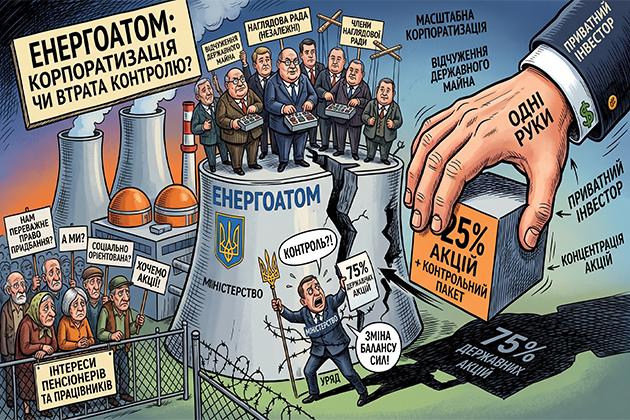
Therefore, the proposal to sell—meaning to privatize—25 percent of the shares of the Joint-Stock Company "National Nuclear Energy Generating Company "Energoatom" caused no surprise. Yet, certain details are unsettling. Why exactly 25 percent of the shares, and why into "a single hand"?
If the state retains 75 percent, this will not allow it to pass resolutions on many critical matters of the company's operations. Won't such a sale mean a loss of control? In this situation, perhaps we should turn back and recall the good old rule: to grant the employees—and, as an option, the retirees—of the Joint-Stock Company "NNEGC "Energoatom" a preemptive right to acquire shares in the event of their privatization?
This would both serve as an expression of gratitude for their many years of labor at the enterprise, and allow the 25 percent block of shares to be divided, preventing its concentration in the hands of a single individual. Perhaps this is what a multi-structured, socially oriented market economy actually looks like.
"Energoatom" into a Single Hand? Why the Privatization of 25% of Shares Alarms the Industry
№10-11 (1419-1420) від 23.03.202608.06.2026 16:00
The history of Ukrainian privatization, which began in 1992 with a course toward a socially oriented market economy, has transformed today into a large-scale corporatization of strategic assets. Taking "Energoatom" as an example, it becomes obvious how the reform of state-sector management is shifting the balance of power between specialized ministries and supervisory boards. Will the concentration of 25 percent of the energy giant's shares in a single hand lead to a loss of state control, and is there an alternative path that takes into account the interests of the workforce and the industry's retirees?
Latest articles
UKRAINE'S NEW ENERGY IS BEING BUILT ON OLD INFRASTRUCTURE: What challenges face the industry
Электроэнергетика 30.06.2026 14:06
Ukraine is actively developing new generation, energy storage systems, and hybrid energy solutions. At the same time, the implementation of such projects takes place under conditions where modern technologies must be integrated into an infrastructure, a significant part of which was created decades ago.
Электроэнергетика 26.06.2026 15:58
The idea of "coal-to-nuclear" might initially sound like an energy sector meme. It implies that we can simply take an old coal-fired thermal power plant, remove the boiler, replace it with a reactor, and effortlessly produce a beautiful story about the "green transition." In reality, however, the coal-to-nuclear concept is far more profound. It is not about replacing one large "kettle" with another. It is about rethinking the energy site as a strategic asset—encompassing its land, grid connections, water infrastructure, industrial logistics, workforce, regulatory history, and its established role within the power system.

Energoatom: Systemic Crisis and Ways Out
Электроэнергетика 18.06.2026 11:03
The resignation of two independent members of the Supervisory Board of JSC Energoatom is neither an accident nor a personal conflict. It is a symptom of a deeper disease: systemic flaws in the company's management that have accumulated over the years and are now making themselves felt in wartime. The management philosophy in nuclear energy is: "what is not forbidden is not permitted, meaning only what is permitted is allowed"—the price of an error here is simply too high. The Supervisory Board must operate in an intensified mode with unconditional compliance with the laws and regulations of Ukraine. This leads to a much heavier workload than the board members previously anticipated, which became one of the reasons for their resignation.

Who Will Restore the Power Grid: Why the Sector is Losing the Battle for Youth
Электроэнергетика 09.06.2026 16:22
While Ukraine restores its energy infrastructure after massive attacks, another problem is becoming increasingly visible — a human resources crisis. This is not just about a shortage of people, but a deficit of specialists capable of working with complex infrastructure under constant risk and high responsibility.