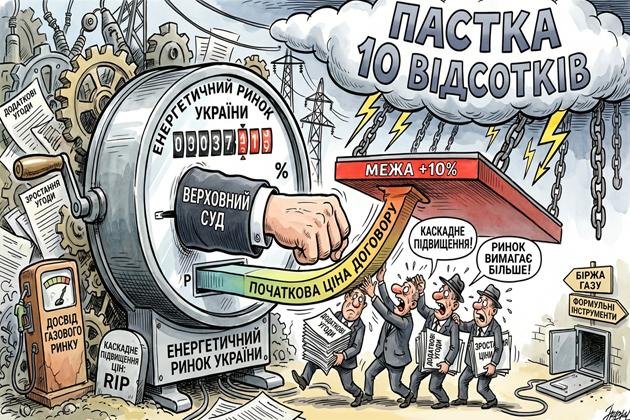

Two judgments of the Grand Chamber of the Supreme Court—dated January 24, 2024, in case No. 922/2321/22 and November 21, 2025, in case No. 920/19/24—have caused quite a stir in the electrical energy market.
These rulings set forth legal conclusions stating that price increases in contracts concluded under the Law "On Public Procurement" cannot exceed 10% of the initial contract amount, as stipulated by Paragraph 2 of Part Five of Article 41 of this Law.
By virtue of the Grand Chamber's status, its conclusions are binding on all courts in disputes regarding electricity pricing for budgetary institutions and organizations. There is simply no way around it.
Granted, there is an opinion that the situation could be remedied by the Constitutional Court, which has received a petition to review the constitutionality of the aforementioned legal provision. We shall wait and see...
Could electricity suppliers have avoided this predicament? Quite easily. It would have sufficed to look at another energy market—the natural gas market.
As it happened, supplying natural gas to budgetary institutions and organizations at deregulated prices became possible much earlier than electricity supply—specifically, since October 2015. Even back then, the issue of price hikes confronted gas suppliers.
Gas price surges forced suppliers to turn to regional offices of the Chamber of Commerce and Industry to obtain documents verifying price growth, which usually exceeded 10%. Within a single delivery month, it became necessary to secure multiple expert conclusions and sign several additional agreements, a practice that later came to be known as "cascading" price increases.
Back then, the prosecution service began filing mass lawsuits seeking to invalidate such price-escalation agreements. Judicial practice fluctuated, siding at times with prosecutors and at others with suppliers.
The final point in favor of the prosecution was made by the June 18, 2021, ruling in case No. 927/491/19 by the Commercial Cassation Court’s Unified Chamber within the Supreme Court.
A direct quote is indispensable here:
"...The Law provides an opportunity to increase the price, but by no more than 10%. Any other interpretation of the respective provision of the Law 'On State Procurement' nullifies, devalues, and strips the transparency from the open bidding procedure. The Supreme Court holds that the 10% restriction applies as a maximum limit regarding adjustments to the price specified in the contract, regardless of how frequently such adjustments occur (the number of signed additional agreements)."
In this context, it is irrelevant which law is in effect—the older "On State Procurement" or the current "On Public Procurement." The Supreme Court's logic has remained unchanged since 2021: the price may be increased by no more than 10% of the initial contract value. This remains absolute, regardless of whether the procurement involves gas or electricity.
It is worth noting that certain additional opportunities exist for gas procurement. Specifically, if a consumer—a budgetary institution or organization—purchases gas on a commodity exchange that complies with the Gas Transmission System Code, such procurement falls outside the scope of the Law "On Public Procurement."
As it recalls, formally only one commodity exchange currently meets these requirements. Yet, that is better than nothing.
Naturally, consumers are reluctant to rush to the exchange due to a certain institutional inertia. However, this situation may shift over time.
When it comes to purchasing electricity and navigating price increases, no such alternatives exist; therefore, market participants must operate within the established legal framework. Fortunately, the Law "On Public Procurement" does contain specific mechanisms.
Namely, it permits price adjustments based on changes in exchange quotations or Platts and ARGUS indices, as well as regulated prices (tariffs) and standards applied in the procurement contract, provided that the contract itself explicitly defines the price adjustment procedure.
The electricity market consists of distinct segments: the day-ahead, intraday, and balancing markets. Thus, it is possible to apply a formula to calculate market volatility:
(Average Weighted Price for the Previous Month (DAM + IDM + Balancing) / 3) / (Average Weighted Price for the Settlement Month (DAM + IDM + Balancing) / 3)
Subsequently, depending on the volatility calculation, the price of electricity either scales up or down.
This approach appears far more market-oriented than the framework set out by Cabinet of Ministers Resolution No. 1178 of October 12, 2022, which proposes utilizing average weighted electricity prices exclusively from the day-ahead market.
In any case, suppliers should not sit idle waiting for legislative amendments; instead, they must proactively operate within the boundaries of the existing legal framework.