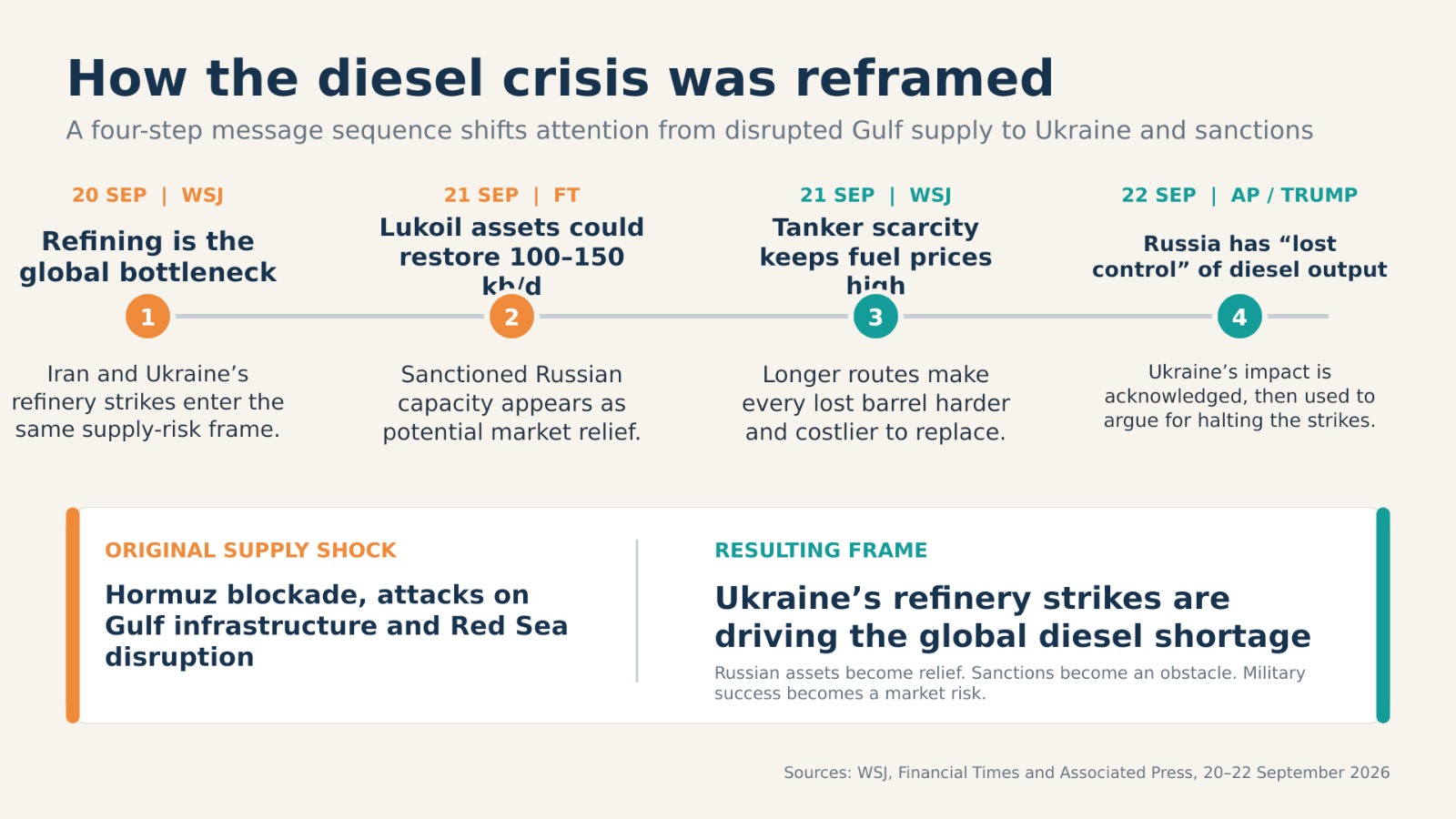

Consider the latest sequence of publications. On September 20, The Wall Street Journal described refining as the main bottleneck in global energy supplies, placing the crisis surrounding Iran alongside Ukrainian strikes on Russian refineries.
The following day, the Financial Times reported on the blocked sale of Lukoil’s international assets, which could supposedly restore 100,000–150,000 barrels per day of refining capacity to the market.
On September 21, the WSJ attributed high prices to a shortage of tankers: VLCC charter rates had exceeded $1 million per day, while rerouting around Africa was adding approximately two weeks to voyages.
A consistent chain of associations is being established: Ukraine’s campaign is forcing Russian refining assets offline or into repair, thereby reducing the supply of diesel fuel.
Together, these claims create a convenient narrative: Ukraine is reducing refining capacity, sanctions are blocking useful assets, and the tanker shortage is preventing the market from replacing the lost volumes.
This framing is now moving into the political domain. According to Axios, the word “diesel” was reportedly repeated numerous times during Trump’s conversation with Zelenskyy.
In an Associated Press article updated on September 22, Trump acknowledged that Russia had “lost control” of its diesel production because a significant number of its refineries had been destroyed or temporarily put out of operation. At the same time, AP recalled that earlier this month he urged Zelenskyy to halt the strikes, linking them to global shortages and rising prices.
This is a particularly revealing contradiction. The effectiveness of Ukraine’s campaign is openly acknowledged, yet its global consequences are being used as an argument for curbing it.
But the original cause of the crisis lies elsewhere.
It is the blockade of the Strait of Hormuz, attacks on energy infrastructure in the Persian Gulf, damage to Saudi Arabia’s East–West Pipeline, and Houthi activity in the Red Sea and the Bab el-Mandeb Strait.
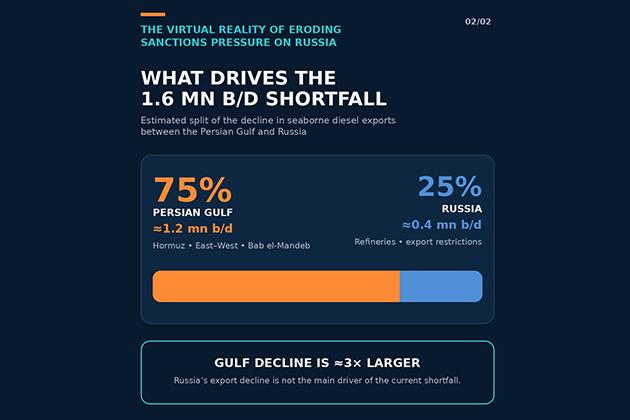
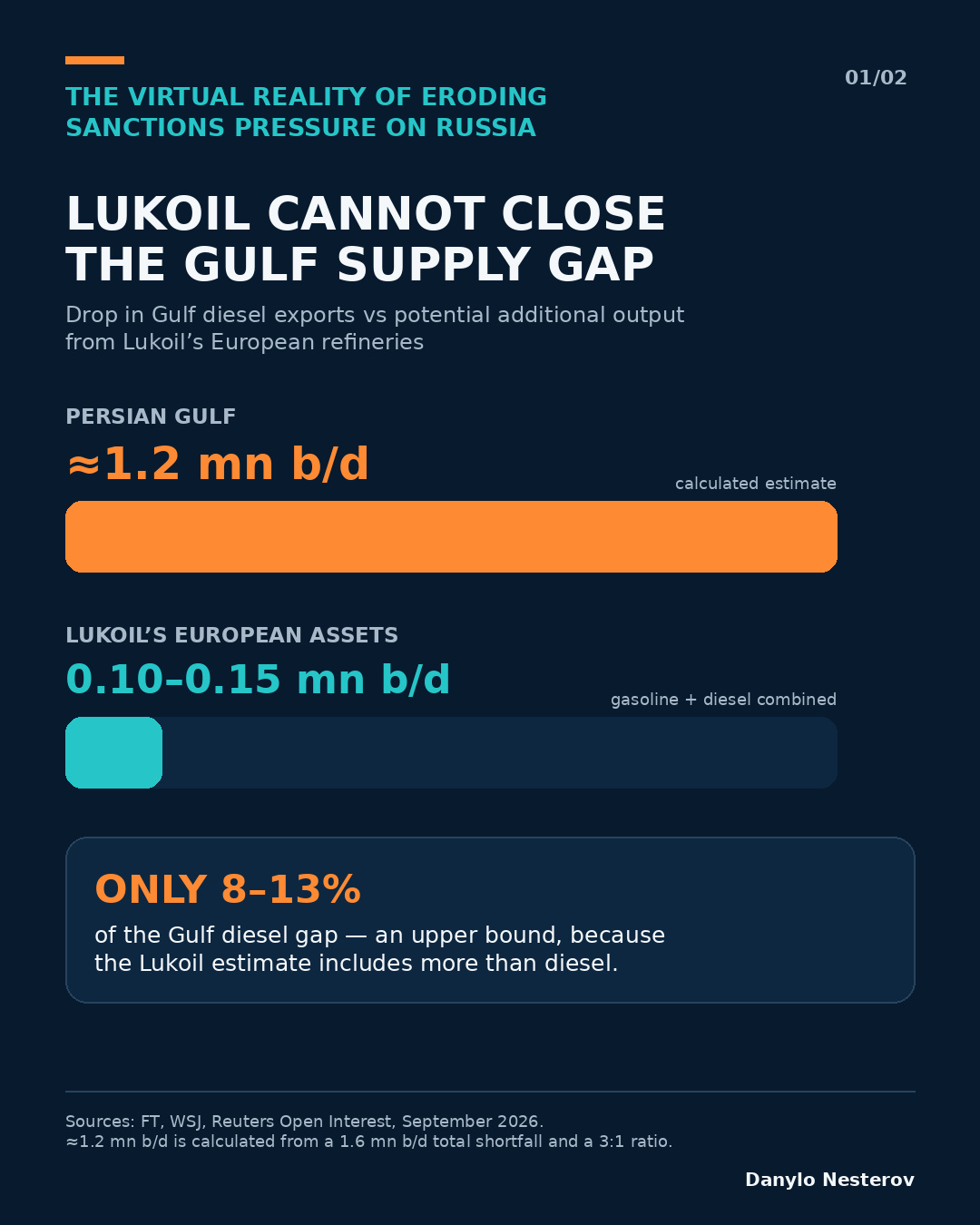
Before the latest escalation, Russia and the Gulf states accounted for almost 45% of global seaborne diesel trade. By August, their combined exports were 1.6 million barrels per day lower than in February. The loss of supplies from the Gulf was approximately three times greater than the decline in Russian exports.
The potential output from Lukoil’s assets could replace only 6–9% of this shortfall. Yet Russian refining capacity is gradually being presented as part of the solution to a global problem.
At the same time, the non-crude component of the U.S. diesel price has risen to almost $4 per gallon since mid-July. Rather than prioritising the supply of a scarce petroleum product to the domestic market, U.S. refiners are actively increasing exports. According to preliminary data, exports in August rose by 37% year-on-year and by almost 30% compared with June.
U.S. diesel inventories are therefore declining while domestic refiners pursue windfall profits and increase exports — yet Ukrainians remain to blame for higher American prices. Instead of restraining domestic producers or limiting diesel exports, the U.S. administration focuses on the suffering of Russian refineries.
Meanwhile, Europe is discussing fuel-tax reductions to offset rising prices and the introduction of a windfall tax on energy companies. This is the opposite of what is happening in the United States.
In parallel, the sanctions mechanism itself is being eroded. France and Slovakia blocked the full renewal of EU individual sanctions, demanding that Alisher Usmanov be removed from the list. As a result, sanctions against almost 3,000 individuals and legal entities were initially extended for only seven days.