
Therefore, the news that Hungary is negotiating future gas supplies from the Romanian Black Sea project, Neptun Deep, is much more than just a commercial story. It is a signal of structural changes in the energy architecture of Central Europe. The change in leadership of the Hungarian government from Orban to Magyar offers hope for an alternative scenario.
Indeed, the shift in the Hungarian government opens up opportunities for diversification. The new administration is interested in improving relations with the EU, and purely for pragmatic reasons: Hungary needs transfers. At the same time, the European Commission adopted the REPowerEU plan for a complete phase-out of Russian fuel imports.
And here are the first results: on May 22, the Hungarian publication Index reported that Budapest is considering Romanian gas as one of the key alternatives to Russian supplies after 2027. Although Hungarian officials publicly avoid using the phrase "phasing out Russian gas," the very fact that such negotiations are taking place demonstrates that even the Kremlin's closest partners are beginning to prepare for a world after Gazprom.
Why Neptun Deep Matters So Much
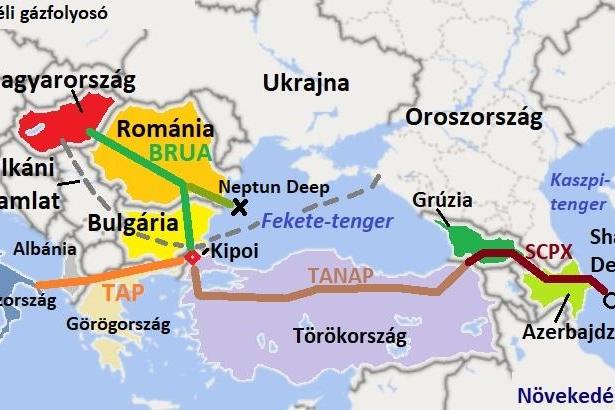
Neptun Deep is the largest new gas project in the European Union in recent years. The field is located in the Romanian sector of the Black Sea, approximately 160 kilometers offshore.
The project is being developed by the Romanian state-owned company Romgaz and Austria's OMV Petrom, a subsidiary of OMV.
Reserves are estimated at approximately 100 billion cubic meters of gas. For comparison, this is more than the annual gas consumption of the entire Central European region.
Following the launch of production in 2027, Romania could double its own output, become one of the largest gas producers in the EU, and transform into a net exporter of natural gas.
This truly changes the rules of the game. Until now, Central Europe had only a few realistic options: Russian pipeline gas, more expensive liquefied natural gas (LNG) through Adriatic or North Sea terminals, or limited volumes of Norwegian gas.
In contrast, Neptun Deep is the first major regional resource physically close to the markets of Hungary, Slovakia, Austria, and even Southern Germany.
This story is particularly crucial for Hungary. The country consumes about 9 billion cubic meters of gas per year, and a significant portion of this volume still arrives from Russia via TurkStream and long-term contracts with Gazprom.
That is why the words of the Hungarian Minister of Foreign Affairs sounded so telling. In a comment to Reuters, he stated: "This new gas field will be the only new source of gas in the region that can realistically contribute to energy diversification."
In fact, this is a public admission that almost no new large sources of pipeline gas exist in the region, and Romania is becoming critically important for the future energy balance of Central Europe.
Negotiations are already underway between the companies and are expected to culminate in an agreement that will mark progress for both nations. This primarily involves Hungary's MVM and MOL Group, alongside Romania's Romgaz and OMV Petrom.
The key factor here is not just politics, but geography. Unlike LNG shipments, Romanian gas does not require complex maritime logistics, does not depend on global LNG prices, and does not necessitate the construction of new terminals. The gas can flow through already existing pipeline interconnectors between Romania and Hungary. For Budapest, this is first and foremost a pragmatic economic decision.
For Bucharest, Neptun Deep is more than just an energy project. It is a chance to move from the periphery of the EU to the very center of European energy policy. Christina Verchere, CEO of OMV Petrom, told Reuters directly: "This gives Romania a significantly more important role in the European Union."
This is a highly accurate phrasing. Previously, Romania was rarely considered a key energy player in Europe. Now the situation is changing: Bucharest is gaining access to potentially the largest new gas resource in the EU, becoming an essential supplier for Central Europe, and turning into a vital element of the entire European Union's energy security.
Christina Verchere also emphasized: "When Europe has access to its own natural gas, we must develop it and ensure it reaches the market." This formulation captures the entire current logic of European energy policy: relying on domestic or regional resources rather than Russian imports.
For Russia, Neptun Deep is dangerous not only economically but also politically. For decades, the Kremlin maintained its influence in Central Europe precisely through pipeline gas, long-term contracts, and the argument of "cheap Russian gas." Hungary and Slovakia were the textbook examples of this dependency model.
Now, a fundamentally different situation is emerging. An alternative is becoming physically accessible, located within the EU, controlled by European companies, and independent of Russian infrastructure.
Interest in Romanian gas is being shown not only by Hungary but also by Slovakia and Germany. This means we are witnessing the formation of a new energy axis for Central Europe, rather than just a local Romanian project. And this is perhaps the most critical takeaway from the entire story.
After 2022, Europe learned to live without the majority of Russian gas. However, Central Europe remained the most challenging region due to its historical dependence on Russian pipelines. Neptun Deep could provide the first realistic scenario for breaking this dependence.
At the same time, it is too early to speak of a rapid rupture with Russian gas. TurkStream continues to operate, contracts with Gazprom remain in force, and Russian gas still holds a significant share of the Hungarian market.
Furthermore, production at Neptun Deep will only launch in 2027, the project requires the completion of infrastructure, and regional interconnectors must be expanded. Therefore, this is not an overnight rejection of the Russian Federation, but a gradual, structural pivot.
Yet, even this pivot carries immense geopolitical significance. For decades, the main myth of Russian energy policy was that Central Europe could not function without Russian gas. Neptun Deep is the first large-scale project to realistically challenge that argument.