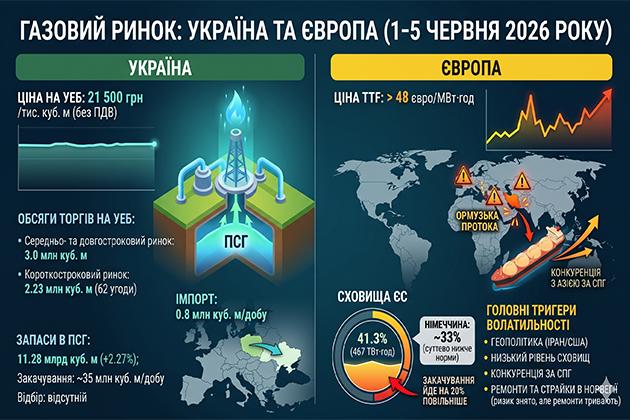
In the "Medium- and Long-term Market" section, trading for June and July 2026 resources continued. In total, 7 companies formed buying or selling positions, including VK Ukrnaftoburinnia, Gas Supply Company Naftogaz Trading, MHP Eco Energy, and the Gas TSO of Ukraine, among others. During the week, 3,000 thousand cubic meters of June resource gas stored in underground storage facilities (UGS) were sold here. Notably, Ukrzaliznycia's buying position was successful at a price of UAH 21,500 per thousand cubic meters excluding VAT. Overall, market participant activity was not high at the beginning of the month.
In the short-term natural gas market of the UEE, participants submitted bids on the intraday and day-ahead markets, concluding 62 transactions with a total volume of 2,230 thousand cubic meters.
European Market: Geopolitics and Injection Rates Pressure Prices
In the European market, the current weekly baseline scenario remains a wide TTF corridor with a risk of sharp rebounds. At the end of the week, TTF quotes held above EUR 48/MWh, heading toward a weekly gain. Compared to Ukraine's price of EUR 44.6/MWh, the European market carries a noticeable premium. The market's main signal is the absence of a comfortable gas surplus. Low inventory levels in storage, fierce competition for LNG, and the winter premium in the energy segment limit the room for a sustainable price decline.
The geopolitical factor once again exerted upward pressure on prices. US-Iran negotiations regarding safe shipping through the Strait of Hormuz showed no clear progress. The risk of prolonged disruptions in the Persian Gulf returned, which was reflected in the price. For Europe, this threatens a reduction in available spot LNG cargoes and stronger competition with Asia.
As of June 3, 2026, European gas storage fullness stood at approximately 41.3% (467 TWh). While this is higher than at the end of May, it remains below the comfortable seasonal trajectory. Furthermore, regional asymmetry is being observed: Germany's inventory level is around 33%, which is significantly lower than usual for the beginning of June. Since the start of the spring season, injections in the EU have been running about 20% slower than last year.
Regarding pipeline gas, prices were driven up early in the week by the risk of a strike in Norway that was set to begin on June 5. However, this risk was resolved on Friday following an agreement between the operating companies and trade unions.
US LNG exports fell to 10.2 million tons in May due to maintenance, while the share of shipments to Asia grew on the back of a more favorable JKM/TTF spread. Europe remained the top destination for American LNG, but its market share decreased.
Imports and the Situation in Ukrainian UGS
Natural gas imports from Europe during the reporting period stood at 0.8 million cubic meters per day, representing a 27% decline compared to the previous week. These supplies came exclusively from Poland. Gas exports from the "customs warehouse" regime were absent.
Ukrainian underground gas storage facilities (UGS) held 11.28 billion cubic meters of gas (+2.27%). Withdrawal of the blue fuel was virtually non-existent; instead, injections continued at a rate of approximately 35 million cubic meters per day.