
How Naftogaz Is Suffocating District Heating Companies
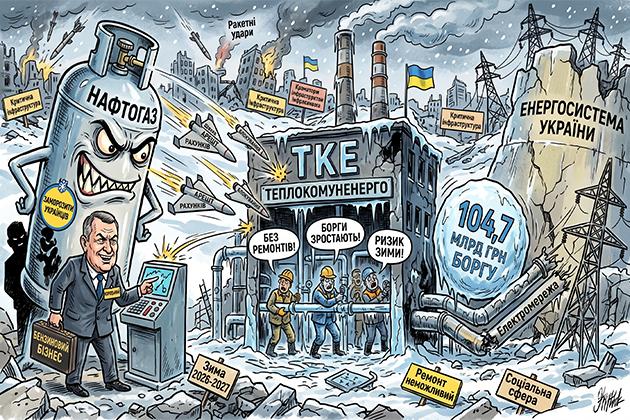
Ukraine’s district heating companies are facing the most massive crisis of the last 20 years: they cannot pay for gas, they cannot pay for services and equipment, they cannot settle debts, and they cannot repair heating networks. And all of this is happening against the backdrop of war, shelling, and the destruction of thermal power plants (CHPs) and boiler houses. Naftogaz's pressure on TKEs is occurring during what is truly the most challenging period for both the power grid and the heating system, both of which suffered heavily during the previous heating season.
Naftogaz's Predators Led by Koretsky
Just a few months ago, it seemed that the biggest problem in preparing for the next heating season would be the gas deficit and the repair of damaged CHPs. However, after Naftogaz launched its own metaphorical "Iskander" missile against TKEs, the paralysis of heat generation has now become problem number one.
In fact, by making such a decision, Naftogaz is turning its back on the people. About 90% of the population in major cities and nearly 50% of the entire population of Ukraine rely on district heating services. In winter, they could simply freeze if TKEs are stripped of the ability to prepare for the heating season.
The culprits actually have names and surnames. The party responsible for such a predatory policy at Naftogaz is the company's management board, headed by Koretsky, who comes from the gasoline business. The head of Naftogaz brought in representatives of private companies—his former business colleagues—who view Naftogaz exclusively as a business project.
Consequently, they completely lack an understanding of the heating system and TKEs as an interconnected social sphere upon which the vital functions of cities, citizens, schools, kindergartens, and hospitals depend.
Accordingly, through this purely "business" lens, Naftogaz viewed the gas debts of district heating companies. Owe money? Go bankrupt, but pay up! Indeed, the Energy Committee of the Verkhovna Rada disclosed a staggering TKE debt amount—UAH 154.5 billion. However, Naftogaz modestly keeps quiet about the fact that over UAH 60 billion of this sum consists of the so-called "tariff difference," where the state is supposed to compensate for the gap between the actual cost of heat production and what the consumer pays. How Naftogaz managed to see this as a problem created by the heating utilities rather than the state as a whole is hard to comprehend.
If Koretsky and the Naftogaz board wanted to punish someone for these debts, they should have blocked the accounts and cut off gas supplies to the current Prime Minister Svyrydenko, or former Prime Ministers Shmyhal or Groysman, under whom memorandums were signed between heating enterprises, local authorities, and Naftogaz. Those agreements effectively froze heat tariffs for the population.
As the brilliant Ukrainian writer Mykola Gogol wrote in the epigraph to The Government Inspector: "Don't blame the mirror if your own face is crooked." Similarly, Naftogaz blames TKEs for the debts, while being the very reason they appeared.
After the Heat Market, the Electricity Market Will Collapse
By the way, the largest chunk of the UAH 154.5 billion debt belongs to natural gas liabilities—UAH 104.7 billion. The largest debts are recorded before LLC "Gas Supply Company Naftogaz Trading"—UAH 67.4 billion. Moreover, these debts emerged during martial law and can be resolved through a separate decision or a law establishing a debt restructuring mechanism.
With Naftogaz treating heating enterprises this way, Ukrainians should brace themselves and wonder whether there will be any heat in their apartments at all. After all, the preparation process for district heating companies has effectively ground to a halt. With such approaches from the Naftogaz board, the only viable advice come October-November 2026 will be to flee major cities, where a collapse of centralized heating could imminent.
Representatives of TKEs today view Naftogaz's "attack" on the heating sector as a deliberate attempt to destabilize the industry and drive district heating enterprises into bankruptcy. And if anyone thinks that Naftogaz only "hit" specific, notoriously bad debtors, it is a false impression. Practically all district heating companies have suffered from Naftogaz's account blocking.
Roman Polishchuk, CEO of LLC "Kramatorskteploenergo," points out examples of aid from international partners for his enterprise, which is virtually on the front line, as well as UAH 5 billion in successful lawsuits won against Russia. Yet, from the state-owned company Naftogaz, the heating workers of "Kramatorskteploenergo" received a big fat "nothing"—just like everyone else, their accounts were blocked, pushing those Ukrainians who remain in the frontline city to the brink of survival. For the record, 52,000 residents live there. And Naftogaz seemingly has no use for these Ukrainians.
The employees of "Kramatorskteploenergo" continued to fulfill their social duties and provided heat to the Kramatorsk community. Among other things, they expected the government to fulfill its obligation to cover the tariff difference for production—to date, this sum stands at UAH 576 million. Naftogaz knows this perfectly well, yet they pretend the blame for this situation lies entirely with the heating workers of Kramatorsk.
Furthermore, Naftogaz's management fails to realize that its decisions in the gas and heat markets have already triggered a chain reaction in the electricity market. The freezing of TKE accounts and their inability to pay for electricity have sparked yet another debt crisis. Heating utilities are not paying for electricity, but they continue to consume it. Consequently, electricity suppliers are effectively financing critical infrastructure with no clear understanding of when TKEs will be able to settle their debts.
The company "Energy 365" has already warned that the process of spilling the debt collapse from the heating sector into the electricity market has begun. To prevent a payment crisis for electricity, the government, NEURC (National Energy and Utilities Regulatory Commission), and Ukrenergo must adopt a series of decisions. The problem is that TKEs continue to consume electricity to run boiler houses, pumping stations, heat distribution points, cogeneration facilities, emergency services, and other critical infrastructure, but due to frozen accounts, they cannot properly make current payments to electricity suppliers.
Experts from "Energy 365" have reached out to other market participants. In this situation, electricity suppliers face a difficult choice: either effectively extend credit to a critical consumer (district heating companies) without a clear source of payment, or initiate a shutdown of supplies, which could jeopardize preparations for the heating season and the continuous operation of heating facilities.
Following Naftogaz's path and restricting enterprise accounts is a dead-end solution that only deepens the crisis. "Energy 365" notes that mechanically transferring troubled TKEs to the "supplier of last resort" (SOIR) does not address the root cause of non-payments. It merely shifts the debt burden onto another market segment, escalating risks for the SOIR, Ukrenergo, and the balancing market.
In other words, the problem of Naftogaz, the gas market, and the heat market is gradually becoming a crisis for the electricity market. In a short while, a wave of non-payments will hit electricity distribution system operators, NPC Ukrenergo, and the balancing market. When that happens, the chairman of the Naftogaz board, Koretsky, will be summoned "to the carpet" in the Verkhovna Rada and to government meetings, forced to make excuses before international organizations, because the TKE debt issue will have snowballed into a crisis for Ukraine's entire energy market.
To expect Naftogaz to admit its mistakes and work toward restoring stability in the energy sector is an overly optimistic scenario. The realistic scenario involves appropriate decisions from the Cabinet of Ministers and NEURC to bring Naftogaz's leadership to their senses and halt the onset of energy chaos.
At the political level, there is also an understanding of the catastrophe being triggered by Naftogaz's actions. Vadym Filashkin, Head of the Donetsk Regional Military Administration, has already appealed to Vice Prime Minister Kuleba regarding unfreezing the accounts of several enterprises in the region, as well as reimbursing the tariff difference for "Donetsk teplokomunenergo," "Kramatorskteploenergo," "Voda Donbasu Company," and others. The primary issue is the complete inability to conduct preparations for the 2026–2027 heating season.
Simple Solutions
All solutions are right on the surface, quite simple, and can be implemented rapidly. The first step must be a moratorium on the forced debiting of current payments and the creation of separate, dedicated special accounts for electricity settlements. This would bring TKE operations back to normal and prevent winter preparations from failing completely.
The next stage should be restoring the full operation of the tariff difference compensation mechanism. Once TKE enterprises start receiving their billions for the tariff gap, positive shifts will also be felt by Naftogaz itself, which acted as the detonator of the crisis in the heat market.
The third crucial step involves temporary amendments to NEURC Resolution No. 332 "On ensuring the stable functioning of the electricity market, including the financial state of electricity market participants during the period of martial law in Ukraine."
The resolution needs to review and soften sanctions for TKEs as part of critical infrastructure, guarantee debt restructuring mechanisms, and ban automatic disconnections of enterprises that fulfill a vital social role for the population (TKEs).
If at least these decisions are made, ordinary current TKE payments for electricity and gas will automatically be decoupled from tens of billions of hryvnias in historical debts. Furthermore, district heating companies will be recognized as critical energy infrastructure facilities, and their financial administration will be regulated by separate government and NEURC decisions.
Ukraine was one step away from disaster in January-February 2026, when Russian missile strikes pushed heat supply systems, CHPs, and TKEs to the brink of survival in certain cities (Kyiv, Kharkiv, Kryvyi Rih, Zaporizhzhia, Dnipro). Consequently, Ukrainians were forced to live in "refrigerator apartments" with sub-zero temperatures for nearly two months.
Naftogaz and its management must draw the appropriate conclusions and abandon destabilizing actions against TKEs, which, even without Russian missiles, could lead to a catastrophe in the winter of 2026–2027. After all, the operation of district heating companies is a paramount element of Ukraine’s energy and social security.