The Economics of Biomethane Amid Geopolitical Shifts
— How does the current spike in gas prices caused by the conflict in the Middle East affect the economics of biomethane?
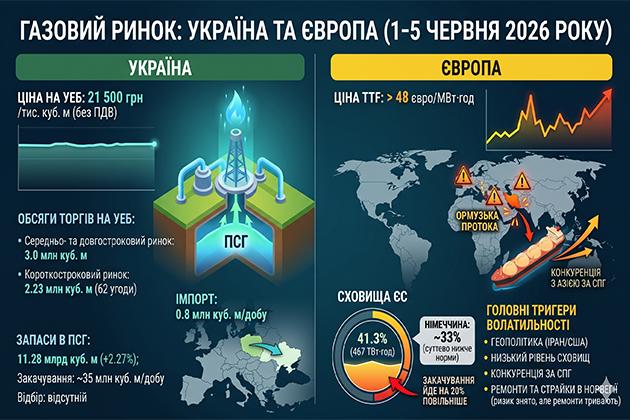
— It definitely provides an additional incentive for the industry's development. Typically, the winter price of natural gas on European hubs is around €450 per thousand cubic meters, and the summer price is about €300. Recently, I checked and the price was €550 per thousand cubic meters. And we are talking about late March or early April. Essentially, now that the heating season has ended, it should have dropped to €300–350. Instead, it is €550. Roughly speaking, it is €200 per thousand cubic meters more expensive than usual.
Consequently, biomethane can now be sold for virtually €200 more. How is the price of biomethane structured? It equals the price of natural gas plus a premium for decarbonization (for emission reductions). This premium remains unchanged, while the cost of natural gas has increased by €200. The difference between €900 and €1,100 per thousand cubic meters of biomethane alters the project economics entirely.
Of course, biomethane contracts are not signed for just a single day — they are concluded for a year or even longer. Therefore, it is not a given that the €550 price will hold throughout the entire year. However, right now, it serves as a significant boost. The uncertainty regarding how long these prices will last also plays a role: what if they go even higher? While this is detrimental to the broader economy, it benefits biomethane by adding extra value to an export product.
Current Production and Plant Infrastructure
— How much biomethane is currently produced in Ukraine, and how many facilities are operational?
— There are six plants. The sixth one was launched just this past March — it is brand new. Notably, it is massive: its capacity equals that of the first five plants combined. The first five produced roughly 52 million cubic meters of biomethane per year, while this sixth plant alone produces 56 million cubic meters annually. In total, this amounts to about 108 million cubic meters of biomethane per year, or 0.1 billion cubic meters.
Ideally, Ukraine needs about 20 billion cubic meters, so this is just the beginning of the process. Out of these six plants, three feed biomethane into medium-pressure distribution grids, and one injects it into the high-pressure gas transmission system. The remaining two do not feed into pipelines at all; they liquefy the gas to minus 180°C and transport it in cryo-tankers to the European market as liquid. This is Bio-LNG. It is utilized for heavy-duty trucks and maritime transport, effectively serving as a substitute for diesel fuel. All leading truck manufacturers already offer models compatible with biomethane, and agricultural machinery is available as well. A dedicated market has already taken shape.
Resource Assessment and Sustainable Feedstocks
— What is the total production potential for biomethane in Ukraine given the scale of our agricultural sector?
— We have calculated the potential strictly from waste products — those that can actually be converted into biomethane. For instance, corn silage can theoretically be grown and processed into biogas. However, this would yield first-generation biomethane, which is not incentivized in Europe. Why? Because silage serves as animal feed. If the feedstock consists of crops or food products rather than waste, it falls under first-generation biofuels, which Europe is phased out of to prevent competition with food production.
Therefore, we do not include silage in our calculations. On the other hand, liquid manure, poultry litter, straw, corn stalks, and municipal waste are formally classified as waste and are suitable for our assessments. Sequential or cover crops also fall into this sustainable category.
— What are cover crops?
— It is a second harvest grown on the same field. For example, winter wheat is harvested in June, and the next winter crop is sown in September or October. The field remains empty for three to four months, and during this window, green biomass can be planted. Even if this turns out to be corn silage, it is classified as an sequential crop and does not compete with food production. The primary crop has already been harvested, and whatever grows additionally can be utilized for energy. This approach is codified in EU regulatory logic.
Furthermore, we calculated cover crops for only 20% of the arable land — a realistic figure that accounts for crop rotation. If we assumed 40%, farmers would point out that it is unfeasible due to rotation disruptions. Consequently, our estimated potential stands at 21.8 billion cubic meters of biomethane per year. This is slightly higher than Ukraine's current annual natural gas consumption.
— What raw materials do the operational plants utilize?
— Two MHP plants run on poultry litter. All the others primarily utilize liquid manure — from pigs and cattle — along with poultry litter and crop residues like a bit of straw. Sugar beet pulp, a byproduct of sugar refineries, is also widely used. However, there is a nuance: pulp can theoretically be fed to cows, so it may not automatically be classified as waste. To secure waste status, producers must prove to auditors that there are no cattle within a radius of, say, 100 kilometers from the sugar plant that could consume it. If you "take" the pulp away from cows, it is categorized as feed, and the resulting biomethane falls into a lower price tier.
Third-Party Investments and Business Models
— It is fascinating that the feedstock must hold verified waste status. Currently, biomethane plants operate as vertically integrated projects where companies process their own waste. Are there any independent investment projects focused strictly on biomethane production?
— All six operational plants indeed process their own industrial waste. However, two independent investment projects are currently under development: feasibility studies have been completed, and engineering design is underway. A loan from the EBRD is under negotiation; a preliminary agreement has been signed to finance the construction of these two plants. They are currently undergoing the due diligence process.
— How is such an investment project structured with an external investor?
— The model is straightforward: there are two large swine facilities and an external investor who secures long-term feedstock supply agreements with them. The pig farms guarantee a steady supply of liquid manure, and the investor constructs the plant. Following anaerobic digestion, the digestate (the nutrient-rich organic fertilizer remaining after processing) is returned to the farms' fields, resolving their waste disposal challenges.
In addition to manure, the plant sources agricultural biomass, such as straw and corn stalks. The feedstock supplier joins the joint-venture company and receives a share of the profits, ensuring they are invested in the project's success. Their role is to provide land, deliver feedstock, and reclaim the digestate. The investor provides the capital and builds the facility. Such projects are already active in Ukraine; while they haven't launched operations yet, they are progressing rapidly.
Accessing the European Market and Regulatory Hurdles
— How significant is the export clearance granted two years ago, and how is biomethane traded in Europe?
— It is a relatively novel commodity, even for Europe. While there are established exchanges, daily trading, price indices, and various contract terms for natural gas, the same does not yet exist for biomethane — that development lies ahead.
Just a few years ago, unusual incidents occurred: a French producer sought to sell biomethane to the German market, but the local regulator barred the purchase. Court hearings ensued, and the regulator lost because the refusal was deemed discriminatory against a product from another EU member state. This illustrates that even within the EU, the recognition of biomethane as a commodity identical to natural gas developed incrementally.
For now, trading relies on direct off-take agreements. A buyer signs a contract featuring a pricing formula: the natural gas price plus a decarbonization premium. The gas price can fluctuate or be locked in as an annual average. For instance, with a winter price of €450, a summer price of €300, and an average of €400, adding a €500 premium brings the total to €900 per thousand cubic meters for the entire year. This is one common approach.
— How would you describe the market access conditions for Ukrainian companies entering the EU?
— Market access for biomethane from non-EU nations is not yet fully settled. While Ukraine is a candidate country and enjoys certain preferences, the mechanism for seamless trade remains unfinalized. The issue is as follows: a buyer in Germany purchases biomethane to lower their greenhouse gas emissions and meet decarbonization mandates. However, German law currently recognizes these offsets only if the gas originates from within the EU.
A government draft bill has been prepared in Germany to address this: if a country possesses a direct pipeline connection to the EU and the biomethane is registered in the Union Database (UDB) — the unified registry for green fuels — trading is permitted. Ukraine satisfies both criteria. However, the bill has yet to be formally passed.
At the same time, political support is strong. For example, a few weeks ago, Germany’s Minister for Economic Affairs explicitly stated in an interview that Berlin intends to purchase Ukrainian biomethane. There is also a memorandum of understanding between Ukraine and the European Commission regarding cooperation on renewable gases, which explicitly includes biomethane. The Ukrainian side is executing all necessary steps swiftly; the current delays rest primarily with our European partners. The ongoing pricing crisis may accelerate their timeline.
Ukraine's Position Relative to EU Neighbors
— How does Ukraine compare to its EU neighbors?
— The situation is paradoxical: despite the wartime conditions, Ukraine has outpaced Poland, Hungary, and Slovakia. While they possess biogas plants, none of our neighbors currently operate biomethane facilities. The Polish Biomethane Association recently acknowledged that Ukraine is roughly two years ahead of them.
In terms of total biomethane production volume, the EU leader is Germany, while France leads in sector growth rates. Overall, the European Union currently produces about 5 billion cubic meters of biomethane annually, against an installed capacity of 7 billion. The EU aims to reach 35 billion cubic meters by 2030, though most experts are skeptical, expecting a realistic output closer to 20 billion. The subsequent target for 2050 is 150 billion cubic meters, which would effectively replace natural gas entirely with renewable gases.
— Why is the focus on biomethane specifically, rather than hydrogen or synthetic methane?
— Hydrogen remains expensive and is technically unsuited for injection into existing gas pipelines. Synthetic methane is also produced using hydrogen, meaning it faces the same constraints. Biomethane is the only renewable gas that is already commercially viable and actively traded on the market. That is why there is a massive rush toward it right now.
— What role does Ukraine play in this broader transition scenario?
— Once Ukraine joins the EU and we establish a domestic emissions trading system — where a ton of $CO_2$ costs €60–80 — domestic demand for biomethane will emerge. At that stage, production will likely split roughly down the middle: half for export and half for internal consumption. Currently, Ukraine lacks these mechanisms, so all biomethane is geared for export. However, our potential of 21.8 billion cubic meters is substantial enough to position us as a major player in the European market.
The Impact of CBAM and Sustainability Certification
— The Carbon Border Adjustment Mechanism (CBAM) is also approaching, which is starting to press our domestic producers.
— Yes, financial obligations take effect on January 1, 2026. Monitoring will run throughout the entire year, reports will be filed in early 2027, and the initial payments for emissions will be due in the first quarter of 2027. This means that while payments occur later, liabilities accrue for the year 2026.
This doesn't apply to the entire economy but targets specific carbon-intensive sectors: metallurgy, cement, chemicals, and electricity generation. Metallurgical products represent the largest share of our exports. Consequently, steelmakers face a clear choice: you will pay for $CO_2$ emissions regardless. Shipping a ton of steel to Europe carries a specific carbon footprint, and you will be charged that €60–80 per ton at the border, with those funds flowing into the EU budget.
Alternatively, they can purchase Ukrainian biomethane, lower their emissions, and avoid the border tax because their carbon footprint will be significantly reduced. This is where the economic incentive lies. CBAM drives decarbonization even where domestic compliance mechanisms are absent — impacting cement manufacturers, steelmakers, and chemical producers alike.
— How do they verify that Ukrainian biomethane is genuinely "green" and qualifies for emission offsets?
— This process is well-established. There are roughly 15 recognized international sustainability certification schemes, with ISCC EU being the most prevalent in Ukraine. A biomethane producer compiles the documentation, and an independent licensed auditor verifies it to issue an annual sustainability certificate.
The critical metric in this certificate is carbon intensity: the amount of $CO_2$ generated during biomethane production. For diesel fuel, this figure is roughly 82 grams of $CO_2$ per Megajoule; for natural gas, it is 56. For biomethane, it can be zero. Furthermore, if biomethane is produced exclusively from liquid manure, its carbon intensity can drop to minus 100. This means switching from natural gas (at 56) to manure-based biomethane (at minus 100) delivers a net emission reduction exceeding 200%. This specific type of biomethane is in exceptionally high demand, though such metrics are attainable only when working with pure liquid manure.
— That is a remarkable dynamic...
— These certificates are issued by international compliance firms, many of which maintain offices in Ukraine, including Bureau Veritas. They hold licenses to audit against sustainability criteria and are already issuing these certificates to Ukrainian producers.
Biogas vs. Biomethane: Technical Dispersal
— Is it correct that Ukraine produces substantially more biogas than biomethane?
— Yes. There are approximately 83 biogas plants compared to just 6 biomethane facilities. The distinction between them is fundamental. Biogas is the raw product of the anaerobic digestion of organic feedstocks: material is loaded into a digester, heated to around 40°C, and held for three to four weeks in an oxygen-free environment. Bacteria break down the organic matter, releasing a gas compound that is roughly 55% methane and 45% $CO_2$. This raw biogas can be burned immediately in a cogeneration unit to produce electricity and heat. The thermal energy maintains the digestion process, and any surplus can be supplied externally if local consumers exist. If there is no local demand, the excess heat is simply vented.
Biomethane represents the next stage of refining: the $CO_2$ is stripped from the biogas, leaving a gas stream that is 97–98% pure methane. This refined gas meets natural gas quality specifications and can be injected directly into gas grids. This process requires upgrading equipment.
Regarding economics: while the feed-in tariff for biogas electricity was once highly lucrative, most producers have transitioned out of that support framework to sell electricity directly on the market. During peak winter hours, prices reached 15 UAH/kWh, with daily averages hovering around 8–9 UAH/kWh. This is significantly higher than the old fixed tariff. Additionally, the market pays promptly, whereas producers often faced years of delays waiting for full feed-in tariff disbursements.
Thus, the operational logic is clear: if you have access to a waste-based feedstock supply, produce biomethane for export. If you lack waste but have other forms of biomass suitable for biogas, generate electricity for the domestic market.
Necessary State Support and Policy Actions
— What actions are required from the state to accelerate biomethane production?
— Frankly, the government and the Verkhovna Rada have maintained a highly constructive stance toward biomethane. The framework legislation was passed swiftly in 2021 with a constitutional majority, which is uncommon. In 2024, when the necessity for exporting biomethane became clear, amendments to the Customs Code were enacted quite rapidly. A coordination council for bioenergy development operates under the Ministry of Economy, meeting every two weeks under the moderation of Deputy Minister Taras Vysotskyi. This functions as an active administrative body where problems are tracked and decisions are implemented, which explains why we outpaced Poland and Slovakia.
However, several critical steps remain. First, we must activate domestic climate policy mechanisms. Until Ukraine establishes an internal emissions trading market where a ton of $CO_2$ is valued at €60–80, domestic demand for biomethane will remain muted. The Ministry of Economy is working on designing this framework, as it is a prerequisite for EU integration.
Second, we need to foster biomethane adoption within the transport sector. This is commercially viable today given current gasoline and diesel prices. It requires infrastructure, including refueling stations supplying compressed or liquefied biomethane, specialized fuel tanks rated for 200 atmospheres, and compatible vehicles. While this network cannot be built overnight, we can initiate progress with targeted tax policy, such as a zero or minimal excise tax on biomethane used for transport. European nations universally exempt it from excise duties or lower the rates substantially. This intervention would reduce infrastructure costs and accelerate the transition.
EnergoBusiness Profile: Georgiy Geletuha
Personal Details: Born in 1963 in Kyiv. Chairman of the Board of the Bioenergy Association of Ukraine, Doctor of Technical Sciences.
Education: Graduated with honors from Bauman Moscow State Technical University, Faculty of Power Engineering, specializing in "Gas Turbine Engines and Power Plants" (1986). Completed postgraduate studies at the same institution (1988–1992), defending a Ph.D. thesis on optimizing centrifugal compressor design. In March 2021, defended a doctoral dissertation titled "Scientific and Technical Foundations of Energy Production from Biological Fuel Types" at the Institute of Engineering Thermophysics of the National Academy of Sciences of Ukraine (ITTF NASU).
Professional Career:
1998–present: Director of the Scientific-Engineering Centre "Biomass."
2003–present: Head of the Laboratory of Thermophysical Problems of Bioenergetics at ITTF NASU; concurrently assumed leadership of the Renewable Energy Agency.
2012–present: Chairman of the Board of the Bioenergy Association of Ukraine.
2022–2024: Board Member of Bioenergy Europe.
Expertise: Over 25 years of experience in biomass energy technologies. Extensively involved in reforming the bioenergy regulatory framework and drafting feasibility studies for biomethane production facilities. Managed international projects for the German Energy Agency (DENA), the Austrian Energy Agency (EVA), the Danish Energy Agency, and the Japanese corporation Shimizu.
Publications: Author of over 250 scientific and analytical publications, with more than 4,200 citations recorded on Google Scholar.